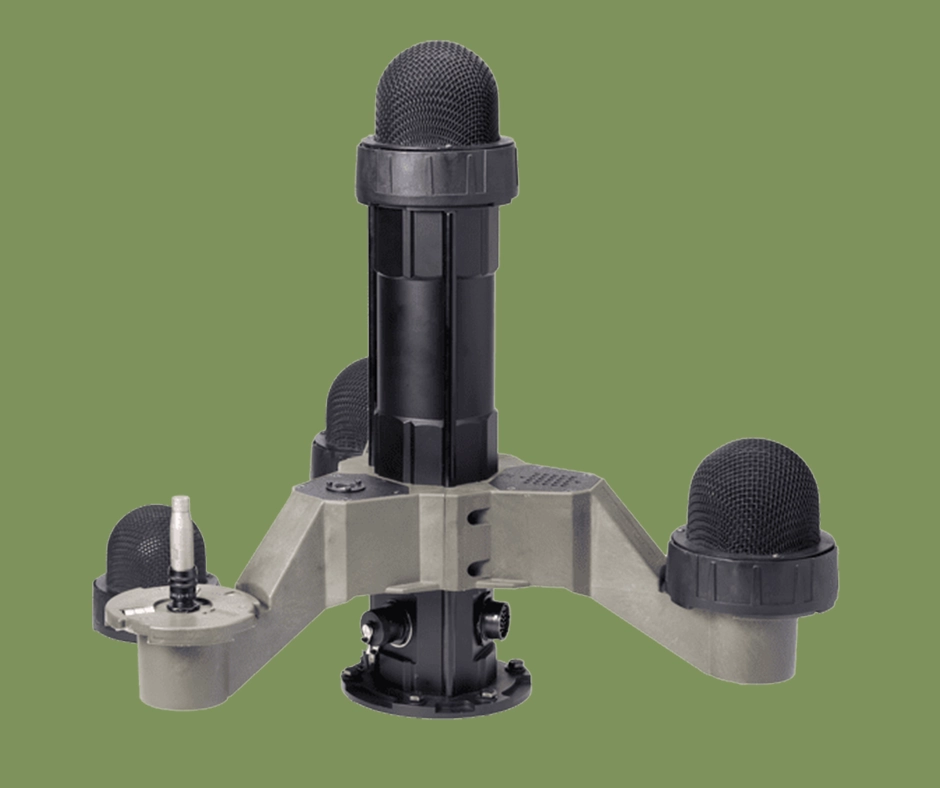
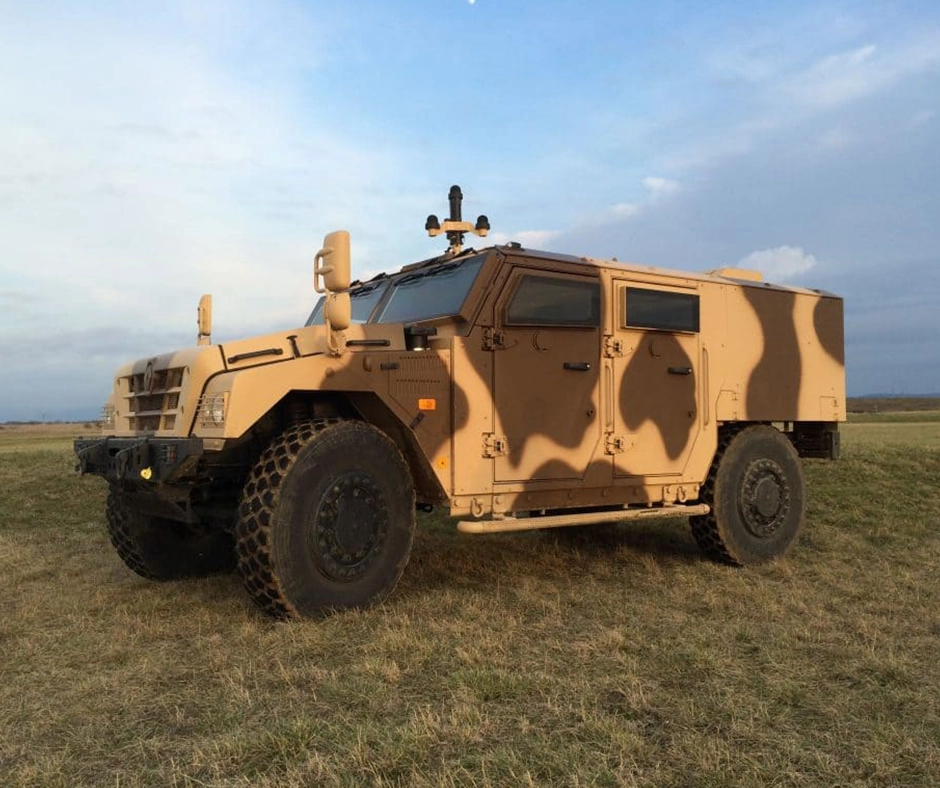
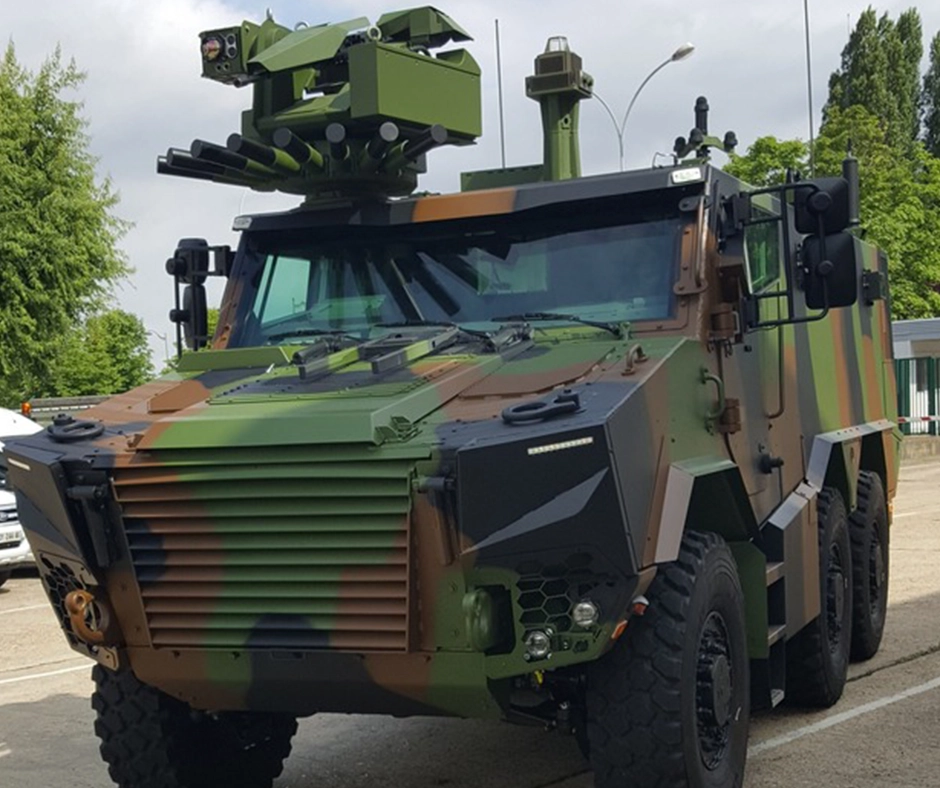
The first steps in the defense sector were taken in the 1990s with joint work with the French defense procurement agency Délégation Générale pour l'Armement (DGA) to examine the acoustic signature of submarines. The DGA & Section Technique de l'Armée de Terre (STAT), the engineering division of the French Army, later commissioned Metravib to find a solution for shot detection, a way to help soldiers who came under fire without knowing exactly where the shots were coming from.
In 1995, the PILAR detector (product for shot detection and localization) was initially designed for UN armored vehicles in Sniper Alley. This area was preferred by shooters positioned in buildings or mountains surrounding Sarajevo. Its main strengths were its compact installation (only four microphones), reliability, and capacity to provide 360° continuous surveillance. After successful tests, the French Army ordered 10 PILAR systems. These systems were deployed to equip special operations command units in Bosnia and Herzegovina, where they were used to enhance troops' situational awareness and security.
When the US Army showed interest in acoustic shot detection, Metravib competed with US, Canadian, and Israeli companies before being selected to collaborate with the US Army in 1999. After receiving the Fielding & Deployment Release (F&DR) certification in 2002, more doors opened for Metravib, providing them access to the broader US Armed Forces equipment market. In the more than 15 years since the first PILAR systems were deployed in Iraq and Afghanistan in the early 2000s, US Special Operations Command purchased over 200 PILAR systems.
The need to integrate shot detection and better field perception technology into a single armored vehicle equipment led Metravib to incorporate electronic design principles into its integrated PILAR IV in 2006. Sensors connect to an acquisition and processing module, connect to a built-in data computer, and combine with remotely controlled turrets. The fourth generation PILAR system also added the significant innovation of 'On The Move' (OTM) technology, which updates shooter coordinates with the vehicle while in motion.
To miniaturize the technology to provide a shot detection system that could be directly attached to a weapon, PEARL (Personal Equipment Attachment for Reactive Localization) was developed in 2013. The proof of concept version was rapidly developed, tested in ground engagement tests, and user feedback was collected. Responses were very positive; PEARL was easy to use, didn't hinder progress in combat or peacekeeping missions, was interoperable, and most importantly, like PILAR, had a very low false alarm rate.
From the beginning, to break new ground in performance and affordability with the new generation PILAR V in 2015, all advantages of PILAR were preserved while the algorithm was renewed to integrate the latest technology and research in recognizing acoustic threat signatures. PILAR V design is more compact and easily integrable into vehicles, providing more awareness of threatening situations and enhanced personal protection. PILAR V performs much better in firearm recognition and calculating shot travel distance. It also detects mortar fire, drones, and helicopter arrivals.
In 2018, a new phase of accelerated innovation began. By researching signature recognition and networking of systems, they were at the forefront of battlefield data evaluation and digitalization. Also, while staying user-focused and anticipating evolving threats on the battlefield and increased use of robots, solutions are being worked on to equip high-noise-producing carriers including helicopters or tracked vehicles. The possibility of leveraging optoelectronics and artificial neural networks to improve analysis and response time is being explored. This research ensures continued leadership in threat detection technology and provides solutions that seamlessly adapt for civilian protection in urban environments.
What is a Gunshot Detection System?
A Gunshot Detection System is an advanced public safety technology designed to detect, locate, and alert law enforcement to gunfire events in real-time. Using a network of acoustic sensors strategically placed in urban areas, the system instantly detects gunfire, determines its exact location, and transmits this data to police within 60 seconds.
This cutting-edge solution utilizes advanced acoustic algorithms to distinguish gunfire from other loud sounds and provides high detection accuracy. Real-time alerts enable law enforcement to respond quickly to incidents, improving emergency response times, enhancing community safety, and providing valuable data for ongoing crime prevention efforts. Gunshot Detection System technology has been deployed in numerous cities worldwide, helping to reduce gun violence and save lives.
What are the Benefits of a Gunshot Detection System?
Police rely on citizens to call 911 and report when gunshots are heard, but on average, only 20% of incidents are reported. This creates a situation where police departments have a significant data gap that makes it difficult to effectively "serve and protect" when it comes to gun violence. The system's acoustic gunshot detection technology fills this gap with a network of acoustic sensors that can detect, locate, and report almost all gunshot incidents to police.
This system is operational in more than 160 cities and is used by police to: 1) Respond to a higher rate of gunshot incidents, 2) Improve response times to crime scenes to better help victims and find witnesses, and 3) Help police find crucial evidence to identify and investigate suspects.
How Does the Gunshot Detection System Work?
The system operates with a series of acoustic sensors wirelessly connected to a cloud-based application across various units. This setup ensures reliable detection and accurate positioning of gunshots using triangulation-based localization. Each acoustic sensor captures the precise time and sound associated with impulsive sounds that could represent gunfire. Advanced machine algorithms then filter this data to classify the event as a possible gunshot. Acoustic experts located and working at the system's 24/7 Incident Review Center ensure and confirm that events are indeed gunfire. They can add other critical intelligence such as whether an automatic weapon was fired or if there were multiple shooters. The truly impressive thing is that this entire process takes less than 60 seconds from the moment of firing to when a digital alert appears on a computer screen at the 911 Call Center or on a patrol officer's smartphone or mobile laptop.
How Effective is the System?
Gunshot detection alone is not a cure for armed violence. However, when used as part of a comprehensive gun crime response strategy, it can contribute to reducing response times, help save lives by getting first aid to gunshot victims faster, and improve evidence collection rates.
How Accurate is the System's Gunshot Detection Solution?
The system is highly accurate in detecting outdoor gunshots. Between 2019-2021, the system has a 97% total accuracy rate across all our customers, including a minimum false positive rate of less than 0.5% of all reported armed conflict incidents.